
MUSEUM MARK CONCORDE PILOT BRIAN TRUBSHAW

‘Faster than a speeding bullet’. Was the phrase used to describe a Concorde flight around 50 years ago in the in 1969.
Today the ability to fly passengers commercially at anywhere near that speed can be only dreamt about. By the youngsters of today.

The helmet worn by test pilot Brian Trubshaw being put on display by Curator Nicola Dowding.
However, for us growing up at that period in the last century we actually saw that happen for real. Mind you we also saw that it was mainly well heeled passengers flying from London or Paris to New York in around 3 hours!
Yes, just over 3 hours!
If you can get there from London now in double that time you are doing extremely well. Even a private jet will not get you there any quicker.
Mind you a private jet will afford certainly more space and luxury that was ever on offer on any Concorde.

Concorde 002 was purely a flying test bed and had no passenger seats.
A modern aircraft ‘economy’ seat of today would be far more comfortable than any seat on a Concorde of yesteryear. The narrow and low cabin allowed for around 92 to 120 seats which were very cosy for their customers.

Concorde flight deck on 002 at the Fleet Air Arm Museum, Yeovilton where you could win a chance to sit in the cockpit!
The business people, politicians, the film stars and the rich that now take up that space in the front of economy section. Were those that mainly sampled that speed too.
They were buying the convenience of breakfast in Britain and lunch with Liberty.
CONCORDE PILOT BRIAN TRUBSHAW
But getting to that stage required the work of specialists like test pilots Brian Trubshaw. And also the first man to fly at 1,000mph in level flight Peter Twiss . A former naval fighter pilot and fittingly the plane he flew stands alongside Concorde 002 at The Fleet Air Arm Museum at Yeovilton in Somerset.
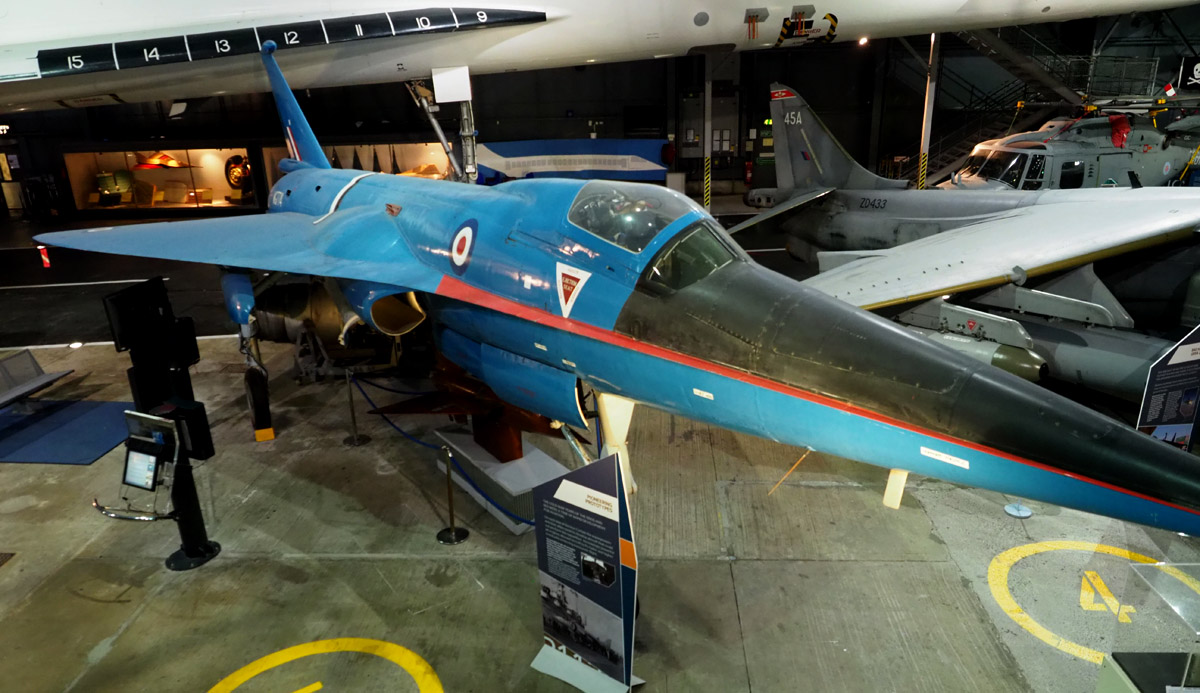
The Fairy Delta II flown by Peter Twiss that contributed to supersonic flight testing of Concorde.
With the anniversary of the first flight 50 years ago. The museum has been able to obtain the safety helmet worn by Trubshaw on the day he piloted Concorde 002 on its first ever flight from Filton in Bristol. The flight was from where here it was built to RAF Fairford in Gloucestershire.

002 was the first British Concorde to fly and is a key part of the collection at The Fleet Air Arm Museum.
This aircraft was built solely as a flying test bed. And although there are some passenger seats in the plane they are only there now to illustrate the seating of that time.
Several Laptops Of Today Could Replace The Electronics
The rest of the aircraft is packed with racks and racks of test equipment and wiring of the time. Although, today those racks of resistors, capacitors and transistors of the late 1960’s could probably be replaced by a couple of solid state laptops of today. As the Museum’s General Manager Marc Farrance remarked.
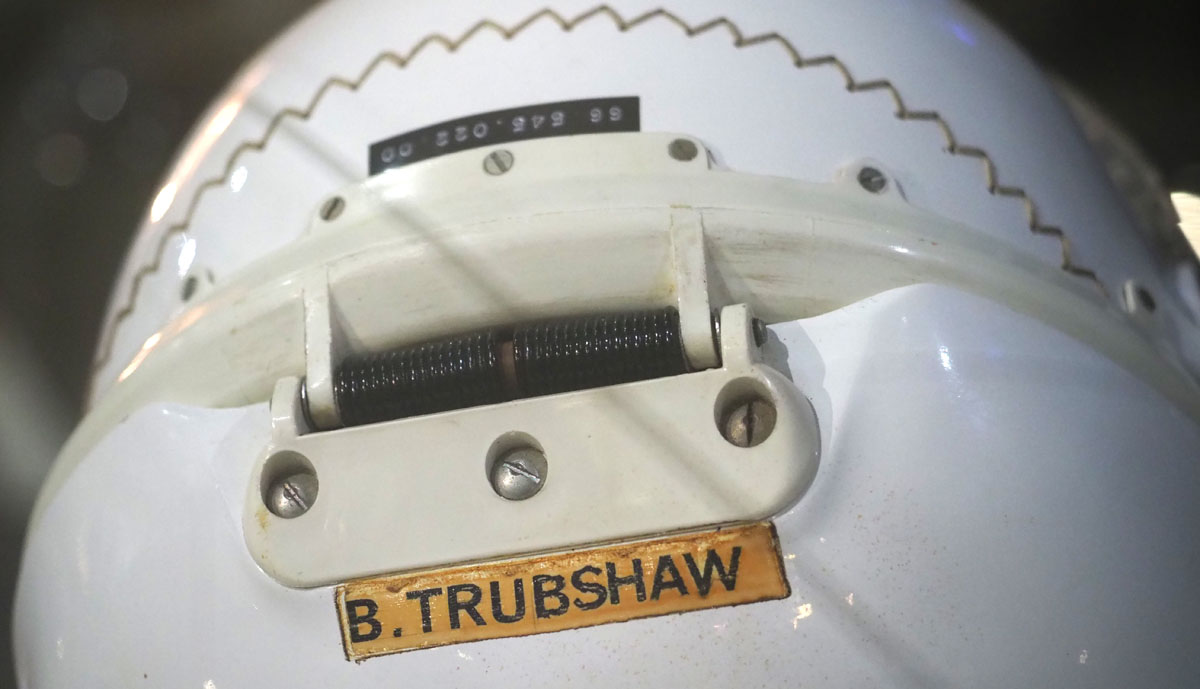
Helmet carrying the name of Brian Trubshaw the first Concorde pilot.
British Concorde pilot Brian Trubshaw also flew the French version. But as the Captain and test pilot of the British one was really where he came to public attention. For his test piloting work for the nation he was awarded the The Royal Victorian Order also the OBE and CBE.

Close-up of the helmet worn by Concorde Pilot Brian Trubshaw.
The space looking safety helmet along with its carrying box was placed beneath the aircraft for the exhibition.
As well as providing a series of special events for the school holidays around that time. On April 9th a large group of enthusiasts will visit on the same day the first and the last British Concorde’s by starting off in Bristol at Aerospace Bristol and then travelling down to the Fleet Air Arm Museum to complete the day some 58 miles away.