Fregate Island Seychelles A Witness To Its Changes

My connections with Fregate Island in The Seychelles go back nearly 30 years and I was there just before it was developed into a 16 villa five star resort.
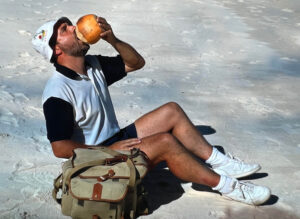
Somewhat younger on a visit to Fregate Island in the 1990s.
And my most recent visit was as one of their last guests before the resort starts a major two year development.
Guest like TV motoring show host Jeremy Clarkson was one of the last to leave.
But it was very special to be invited to this remote wildlife haven of an island that has far fewer visitors than the Galapagos for instance!

All change Fregate Island… The last view before the construction starts.
However, I suspect that many people may not be aware of the diversity of the island wildlife and that some of the rarest animals on the planet live there. And I am not talking about Jeremy!
Welcome To Fregate Island Airport
Certainly, I felt very privilege to return to the island where in its first phase of its life in the mid 1990s it had just one small wooden hotel building. Plus, a 500 metre long grass landing strip. Arriving and departing required nerves of steel for both the pilots and passengers.

Airport Terminal, Fregate Island Private.
The small wooden sign hammered into the ground labelled ‘Welcome To Fregate Island Airport’.
The former boat shed doubled as the terminal at the very end of the runway. Which did seem to approach rather quickly until the pilot braked hard and applied reverse thrust to the twin Otter plane. Bringing us to a safe stop.

Grass runway arriving in the 1990s was by fixed wing now its helicopters at Fregate Island.
Today helicopter transfers are the quickest. The alternative is a boat transfer from the main island of Mahe 35 miles away. Which takes around two hours. Although, often calm the Indian Ocean at times can be the opposite. And for some that two hours can turn into two hours too long!
The next guests are more likely to be construction and environment teams. They will start to prepare both the plants and animals for a brief move to keep them safe until the work has been completed.

All buildings will be taken down and materials will be recycled and reused on Fregate Island Private.
Currently it will mean removal and reuse of the existing buildings. Modifying the layout in order to much improve the efficiency of the whole of the new resort.
Fregate Island Exclusive Luxurious Desirable And Very Green.
Once completed it will put Fregate as one of the most exclusive, luxurious, desirable and environmentally friendly places to stay in the world.
And still with its amazing and unique wildlife intact too, which is a priority.

Typical of the beaches on Fregate Island.
This is an island with some of the most amazing wildlife in the world.
It is home to the Fregate Beetle which is the rarest beetle in the world. Being flightless means it only lives on Fregate.
Also it is home to what at one time was the rarest bird in the world, the Magpie Robin. In the late 1960s there were just 12 birds left all living on the island.

Back from the brink the Magpie Robin of Fregate Island.
After an intense project by the owner to make the island rat and cat free. This aided the start of a breeding programme and now the island boasts a population of around 220 birds.
Eradication of both rats and cats has also helped the Fregate beetle too. Its population was on a worldwide ‘at risk’ zoological list the ‘IUCN red list’.

Fregate Island Beetle.
However, with help from London Zoo and other zoos around the world an off island breeding programme means that should anything happen to the beetle then other populations could be reintroduced back to Fregate.
Turtles Laying Hundreds Of Eggs On The Beaches Of Fregate Island.
Being a rat free island it has helped many other species to make the most of its status. Endangered Hawksbill Turtles lay their eggs on the beaches around the island and so they are safer too. Although the crabs do tunnel into the buried nests and predate the eggs. Here on Fregate there are no lights or many people to disturb the egg laying.

There are seven beaches on the island this one is pretty special would you not agree?
The only likely witnesses are to be the members of the Fregate Island conservation team, who record and monitor each nest.
Acting as guardians to the eggs for up to two months. Although female Turtles can lay up to 4 or 5 nests over the season containing from around 120 to 200 eggs in each.

132 hatclings made it to the sea with this release on Fregate Island, Seychelles.
Then if possible they help the hatchlings to make it safely to the water line. After that they are on definitely on their own.
One In A Thousand Could Survive
However, the survival rate can be as low as one in 1,000 making it to adulthood!
The Giant Seychelles Millipedes are another set of creatures that have developed in size. Something that is a trait of island life, ‘giantism’.
Millipedes up to 15cm in length play one of the most important roles on the island. Providing a food source to some animals. But they also contribute massively to ecosystem by breaking down plant litter through their feeding behaviour.

A Giant Seychelles Millipede Fregate Island.
Their contribution to the fertility of the soil is key to providing the island with its diversity of plants and animals. They all thrive thanks to the millipedes. At night they descend from their hiding places and turn the forest floor into a mass of movement. Road closures ensure that numbers are not reduced by the buggies as they are impossible to miss in such large numbers.
Small Creatures That Make Such A Difference
Another creature that is thriving on the island and this time under the soil. These are the rare, limbless and blind amphibian called a Caecilian.
To most people think they look rather like a worm. On closer inspection it turns out that they are classified at Amphibians.

Looks like a worm but is an Amphibian a Caecilian.
A lumbering, but key worker on the island improving the environment are the giant Aldabra Tortoises. Currently a survey has them at around 2,200 in number.
They help to maintain the forests and keep down some of the foliage. And to some degree they assist the millipedes as they do eat fallen and dry leaves as well as the new green ones.

Magpie Robins follow the Giant Tortoises around chasing insects disturbed by the lumbering beasts.
Probably not pure synergism but the tortoises and the Magpie Robins have a one-way feeding arrangement. Often the robins follow them as they crawl around on the forest floor disturbing insects that the birds pluck up with relish. Not sure what the tortoise gets, but its great to watch.
One other animal also shines out. Well at night, under ultraviolet light the Black Giant Scorpion glows under that light. Strikingly a delightful light shade of light blue.

Glowing Giant Black Scorpion on Fregate Island.
It’s a glowing beacon on any night forest walk as a torch sweeps past one in it’s beam. The intense glow from them is so bright its hard to miss.
Unlike a close cousin of it the Whipspider or Tailess Whip Scorpion. These are found in the forest too. Although, it appears that they are neither a spider or a scorpion. In Latin their name means ‘blunt rump’.
No More Buggies Or Butlers For A While
Over the years I have been lucky to visit the island at different stages in its more recent evolution. My previous visit was in 2011 when I stayed and enjoyed the luxury of cliff top villa No12.
A golf buggy and a butler came with it as you checked in. A choice of 20 pillow types was on offer as well. This time I was returning to experience the start of this coming change. This project was to be about the wildlife rather than the resort.

Filming the unique animals on Fregate Island on this last visit.
I think its uniqueness of its wildlife to me puts Fregate above places like the Galapagos.
More importantly the island wildlife and forest has honestly thrived since the intervention by its owner. With the eradication of none endemic species thus improving and enhancing all the flora and fauna.
Once the careful reconstruction is complete and the landscape has been safely returned, which by the way means moving and recording thousands of plants. It will to then continue to provide a striking forested backdrop, full of diversity in it’s wildlife that will inhabit all the island for those future guests to enjoy and marvel at.
And its only somewhere like Fregate with the owner’s drive to care deeply for this tropical paradise.
A place that I have now witnessed the start of its third change and certainly it appears to me it just seems to gets better each time!