




This Dorset Maiden Will Bowl You Over

Being one of the largest and most complex Iron Age hillforts in Britain this maiden will bowl you over.
Maiden Castle, encompassed by numerous deep ditches and high ramparts that are still nearly as impressive as when they were built, before the Romans invaded.
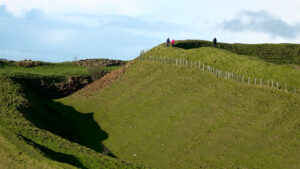
Dorset’s Maiden Castle the large scale of the ramparts .
The huge fortified enclosure has space for 50 football pitches. As it sits high above the Dorset County town of Dorchester. Later called Durnovaria by the Romans.
The town probably came into being after the 2nd Legion Augusta, led by whom later became the Emperor Vespasian. He oversaw the Roman forces invasion of the south west of England.
The hillfort is now under the remit of English Heritage.
Neolithic, Iron Age and Roman Occupation At Dorset Maiden Castle
Making it a truly a fascinating and free outing from the county town or the nearby seaside town of Weymouth.
Although, over the years the ramparts have lost some of their definition due to age and weathering.

Maiden Castle, Iron Age Fort, Dorset.
However, when first built the white chalk bank construction would have been a striking sight in the Iron Age landscape.
Parts of the monument date back to the Neolithic or new stone age period. A later addition with the remains of a Romano British temple are still to be found on the site.
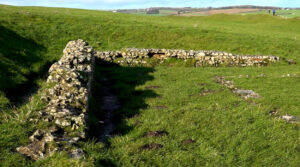
Romano British temple at Maiden Castle.
Its very easy to rack up 10,000 steps exploring the fort’s undulating ramparts. The circular walk around them provides in these Covid-19 times a perfect get-a-way from other people. And a welcome outdoor fresh air exercise experience.
Today The Site Overlooks Prince Charles’s Village Of Poundbury
Views over the Dorset countryside from the ramparts are extensive. Looking to the north from Dorset’s Maiden Castle and to Dorchester and also Prince Charles’ pet architectural project of Poundbury.
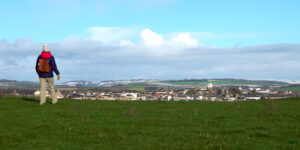
Dorchester and Poundbury in the distance from Maiden Castle.
Back in the 1930’s the archaeologist Sir Mortimer Wheeler made some extraordinary claims about a Roman legion battle and the burning of the encampment and killing of the local Britain’s there. After he found a cemetery with 52 burials.
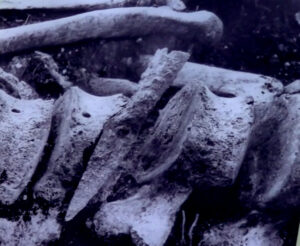
Arrowhead found in a body buried at Maiden Castle. ( English Heritage)
But more recent investigations tell a different story. In the end only a small proportion of them actually died from violent injuries. Buried carefully along with grave goods of beads, brooches, rings and pottery.
The current thinking about them is that these burial rituals do not suggest quickly dug graves after a battle. More likely that they were interred over time and had been involved in local clashes.
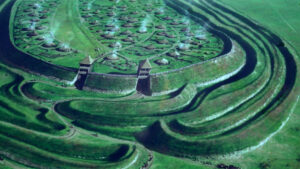
Complex entrance system at Maiden Castle, Iron Age Fort. English Heritage.
At its busiest period the hillfort was occupied by several hundred people living in a series of roundhouses typical of that period. Finds indicate that metalworking and textile production were just some of the key activities on the site.
At One Time 400 Could Have Lived There
Around 43AD after the Romans had become established the fort appeared then to go out of use. A temple was built around the end of the 3rd and start of the 4th century.
The extremely complex entrances at the west and eastern ends to the site would have allowed those coming in and out to be closely scrutinised. Plus making it difficult for invaders to attack too.
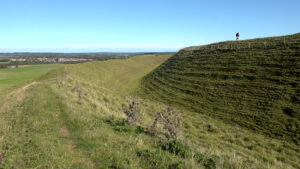
Formidable ramparts and ditches of the Dorset Maiden Castle, Iron Age Fort.
Defenders amassed thousands of smooth sling-stones. Found later in a dig, some 20,000 of them by the east entrance. Probably used to provide ammunition for the defence of the fort. Hence, these rounded pebbles were more likely harvested from Chesil Beach 10 miles away.
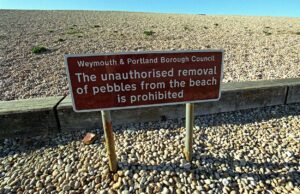
A warning sign not to take pebbles from Chesil Beach nowadays.
Embarking on your peregrination around the ramparts try to consider that it was built with the very crudest of tools. The scale of the fort, the deepness and steep slope of the ditches are indeed still remarkable.
As are the spectacular views in literally all directions from Maiden Castle.
Note: There is a small free car park on the approach to it.
Postcode: DT1 2ER Lat/Long: 50.6949N 2.4698W



Hi, Geoff. This is a great article and I loved learning about Maiden Castle, which I’d never heard of before your post. The video was really helpful in understanding the sheer scale of the earthworks, absolutely incredible! Now on our To Visit List 👍
Thank you for your kind comments.