
Diefenbunker Nuclear Bunker Tour Ottawa Canada

Canada certainly can offer some very different tourism experiences one I wrote about was to a cannabis factory. However this latest one the Diefenbunker nuclear bunker has an underground theme too!
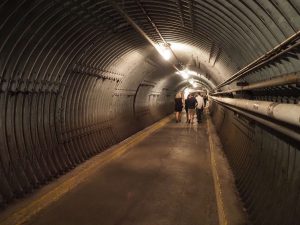
Blast tunnel entrance. The Diefenbunker nuclear bunker
Driving along the 417 Trans Canada Highway northwest from Ottawa and you will arrive at what was Canada’s most top-secret military bunker!
This decommissioned underground nuclear attack proof bunker, is 75 feet beneath the ground of an anonymous and simple looking metal farm or factory building. Hiding under layers of several metre’s thick of reinforced concrete, in total a 100,000 square foot, four storey complex.
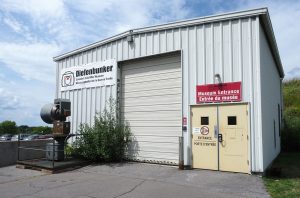
The complex is entered through this plain building.
Ordered to be built by Prime Minister John Diefenbaker back in 1959, in order to house senior military staff and politicians as part of his government’s reaction to escalating tensions in the Cold War, with Russia around that period.
Thick steel reinforcing rods massively larger than standard rebar were used. Then 32,000 cubic yards of hand-poured concrete, thought to be able to withstand a 5megaton explosion were slowly poured to complete the giant shelter.
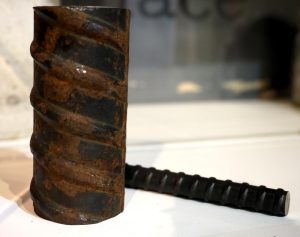
Rebar used in the bunker left, normal building rebar behind.
The nuclear blast roof and walls it was hoped, would allow the Canadian government to operate safely underground for at least 30 days. By then the fallout would have reduced and they would then be able to assist with rebuilding of the country after such an attack.
Many smaller bunkers were built across Canada, but this the federal government bunker was known as the Central Emergency Government Headquarters (CEGHQ Carp).

The Diefenbunker nuclear bunker complex under construction EASE.
The code name for it was ‘Project Emergency Army Signals Establishment’ or (EASE).
This former farm was selected as an area that was a perfect site for such a construction. One key reason was that it was within an easy evacuation distance of the countries Government administration centre in nearby Ottawa.
Plus, the general geological conditions underground added extra protection for it.

The Diefenbaker nuclear bunker complex entrance near Ontario, Canada.
In all the project took 18 months to be completed and was overseen by Lt Col Ed Churchill and engineered by, the Foundation Company of Canada.
It was the first recorded use of critical path construction methodology in Canada as project it was highly complex.
At that time much before computer design. Trying to work out where and how the various floors and rooms all fitted together. Therefore, a special highly detailed model was made so that all involved could see in three dimensions how it would look when finished.
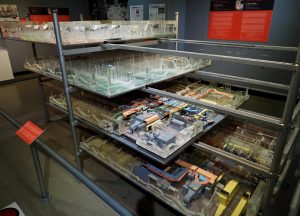
The model showing how complex each level was.
The completed bunker began operation in 1961. It remained in continuous service until it finally closed in 1994.
During those 32 years, it was continually staffed with 100-150 people on a 24-hour shift pattern. The area was made to look like a low-level security military facility, with servicemen and women coming and going day and night.
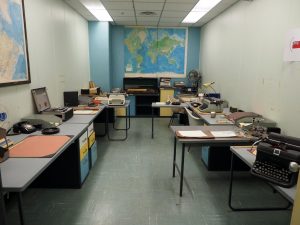
Just one office suite in the nuclear bunker complex.
All that time Canada’s most top-secret communications centre during the Cold War was stocked with enough fresh food and rations to feed 535 people for 30 days. The building was prepared to go into lockdown at any moment.
The Diefenbunker museum which opened in 1997 was set up and they took over the building that had remained empty for three years up until then.
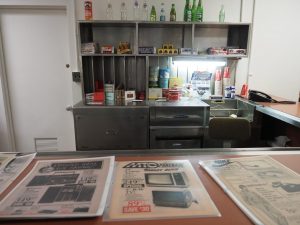
The shop in the Diefenbunker nuclear bunker complex.
Entrance to the complex is through a long straight and down sloping blast tunnel where, after about one hundred metres there is a sharp right turn to enter into the complex.
You are greeted here with a set of solid metal blast doors then allow entrance to the giant multi-level maze.
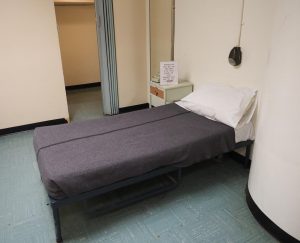
Prime Minister’s bedroom.
Not only were people like military leaders, the Prime Minister and civil servants but a range of medical staff plus catering and cleaning staff too!
Also, the gold reserves from the Bank of Canada were to be retained in a purpose built strong-room as an add on to the complex.
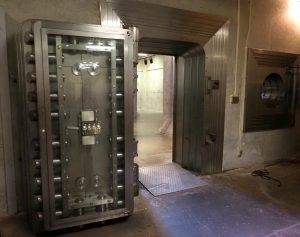
Gold reserves safe to the right the airlock safe too.
Entrance to that was only possible through the 13ton giant steel door where even if you knew the combination of the safe that was of no use as the door was held closed by the pressure inside the solid concrete safe room.
Before that main door could be opened you also needed to know the combination of the air pressure relief safe door too. As until that door was released you could not gain access through the strong-room main door.
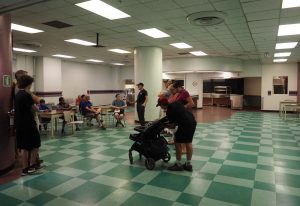
The canteen area in the nuclear bunker.
One other but simple protection for all this gold was an ingenious series of mirrors around the square strong room. This would allow a guard to view the passageways surrounding it from just one point. Therefore, you could not tunnel in whilst the guard was on the opposite side of the strong-room, they had all-round vision of it.
There are so many different rooms on the various floors from the bedroom for the Prime Minister, computer rooms, dozens of offices, catering facilities, a shop, a hospital and an isolation suite should a staff member be contaminated with nuclear fallout.
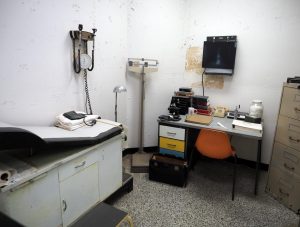
One of the medical rooms.
I did find the whole complex fascinating and saw just a fraction of it. I could have spent a whole day there! There are guided visits in both French and English within the complex or you can just explore on your own.
It’s a real rabbit warren of a place and full of interest at every twist or turn or junction.
Entrance fees are $15.49 (Can) Seniors $14.60 (Can) Students $11.50 (Can)
Youth (6-18) $9.73 (Can)
Monday to Friday: 11:00am – 4:00pm, Box Office Hours: 10:30am – 3:30pm
Saturday and Sunday: 10:00am – 4:30pm, Box Office Hours: 10:00am – 4:00pm
I travelled to Canada with Air Canada and stayed at the Westin Hotel in Ottawa.