

Spectacle of Dorset’s Biennial Swan Round-Up
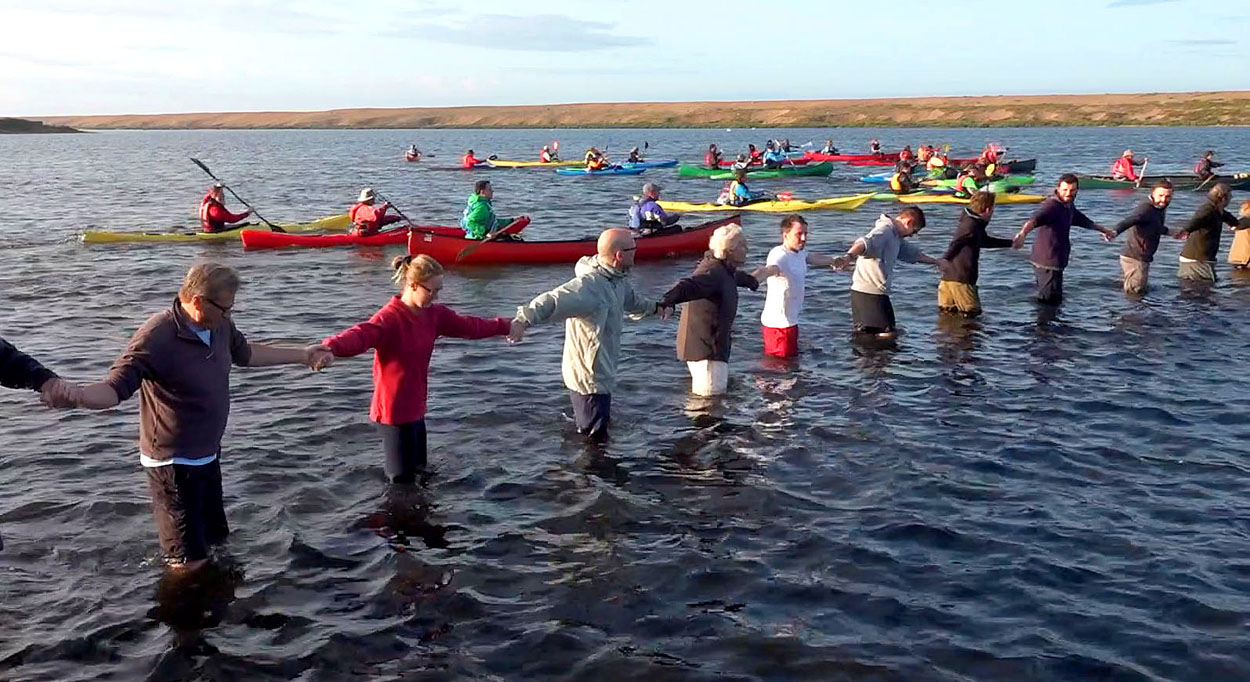
The largest swan round-up in the UK happens every two years on the Fleet Water in Dorset.
Over 700 swans are corralled by canoeists, kayaks and paddling people. As they try to drive the swans to a safe landing shore where they can be counted and checked.
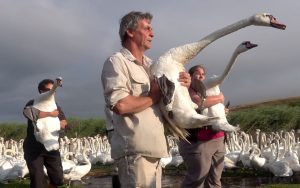
Staff physically catch the swans and hand them over to volunteers at Abbotsbury Swannery in Dorset.
Volunteers come from all over the UK to help in this unusual human and animal meet up.
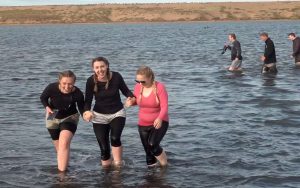
Volunteers have to be prepared to get wet at swan round-up at the Abbotsbury Swannery in Dorset UK.
Around mid-July in the UK the swans molt their feathers and are then unable to fly and then escape the round up.
Round Up Time Is Mid July Every Two Years
As the swans are driven slowly and quietly to the landing beach. Where they can be taken one at a time through a series of checks.
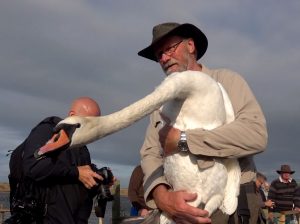
Former Swanherd happy to help out the Abbotsbury Swannery in Dorset.
Firstly, they are assessed to see if their leg rings are attached and in good condition or ringed at all.
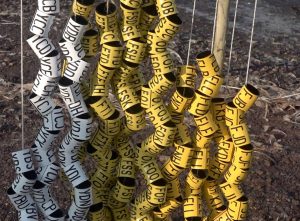
Bird rings at the ready.
Secondly, they go on to a second inspection. By a series of vets whom inject them and if needs be take blood samples.

Weighing station at the round-up at the Abbotsbury Swannery.
Carried by the volunteers the proud looking birds have to get fitted with a weighing harness. This is to help keep them safe whilst they are slung under a trellis to get weighed.
Here sometimes other measurements are taken for their individual records. Plus, also to assess age and overall condition.
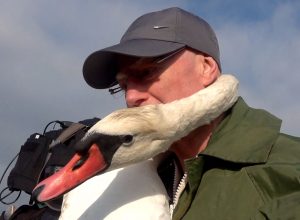
Volunteer carrying one of the 700 birds at Abbotsbury Swannery in Dorset UK.
Once un-leashed from their harness the volunteers continue to carry the birds to a special release point.
Volunteers stand waist deep in the waters of the Fleet lagoon. Then gently place the birds back onto the water. This is where the swan’s flap and paddle noisily over the surface of the water and to freedom. Well for two years until the next round-up.
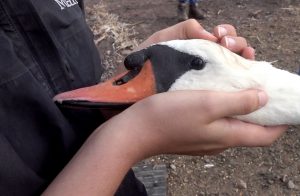
The swans are checked at multiple stations on the day.
Abbotsbury Swannery dates back to the period of the Benedictine monks. Who around 1040 who built a monastery nearby. The Swannery is now under the stewardship of the Ilchester Estates. The monks farmed the swans to produce food for their lavish Dorset banquets.
The Swans Have Been Look After For Nearly 1,000 years
Nearby, St Peter’s monastery was destroyed in 1539, during the dissolution. Some of those ruins can be seen in the village today near the church. This swan colony is now looked after by a special team of wildlife workers. Who feed and try to protect them as far as they can from mostly pesky introduced predators, like Mink, which will take cygnets if they can!
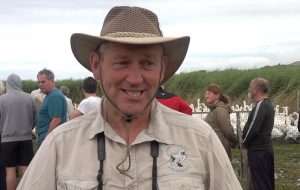
Swanherd Steve Groves at the biennial swan round-up at Abbotsbury.
The Swannery is a well-known tourist attraction in Dorset. Its most popular time is around Spring each year when hundreds of cygnets are born there.
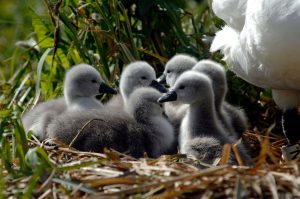
Some of first cygnets born at Abbotsbury Swannery.
As the colony at Abbotsbury are so used to humans this gives a unique chance for visitors to get safely close-up to nesting swans.
A person in charge of such a group of swans is called a Swanherd. And the current incumbent Steve Groves has worked there for 30 years and took on the leading role two years ago.